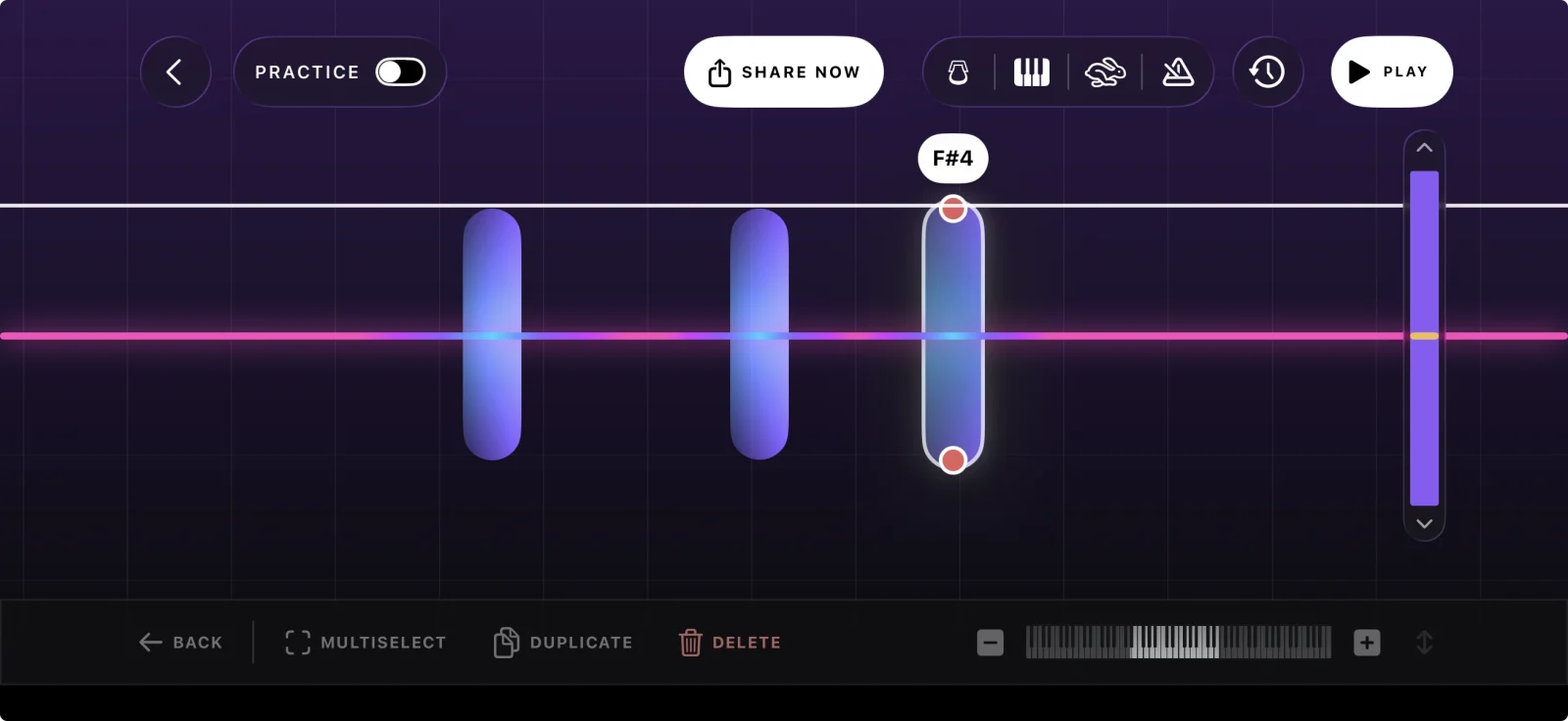
Most songs are three or four chords with a melody on top, arranged so two sections take turns. That is the whole recipe, and you can follow it this week without knowing any theory. Pick your chords first, hum a line over them, write a second section that feels different, then return to the first section. If you want a starting point rather than a method, use C, G, A minor, F, looped, at a slow tempo. And if you already have a loop that sounds finished but will not turn into a song, skip to the section on that below: the problem is almost never the loop, it is that a song is not a loop that grew.
Writing a song sounds like something you earn the right to do after years of lessons. It isn't. Here's the simplest path from nothing to a finished idea.
What if you don't know where to start at all?
Then do not start from nothing. This is the most common reason a first song never happens, and it is worth naming: playing the piano hands you a project, and composing hands you an empty screen. Those are completely different problems, and being good at the first one does not help with the second.
So take a brief instead of freedom. Here is one, and it is deliberately narrow.
Four chords: C, G, A minor, F. One bar each, looped. Sixteen bars total, which is four times round. One instrument. A slow tempo, slow enough that you are never scrambling. Finish it tonight, even badly.
Those four chords work in that order for the same reason a huge amount of pop music uses them: they all belong to one key, so nothing you play over them can sound wrong, and the last one leads back to the first so the loop never feels like it stopped. You do not have to understand that to use it.
The constraints are the point. A brief you did not choose removes the decisions that were paralysing you and leaves only the one that matters, which is what the melody does. Once you have finished one this way, swap a chord and do it again.
Start with the chords, not the melody
Most first-timers go hunting for a tune and get stuck. Flip it. Pick a few chords first and let them carry you.
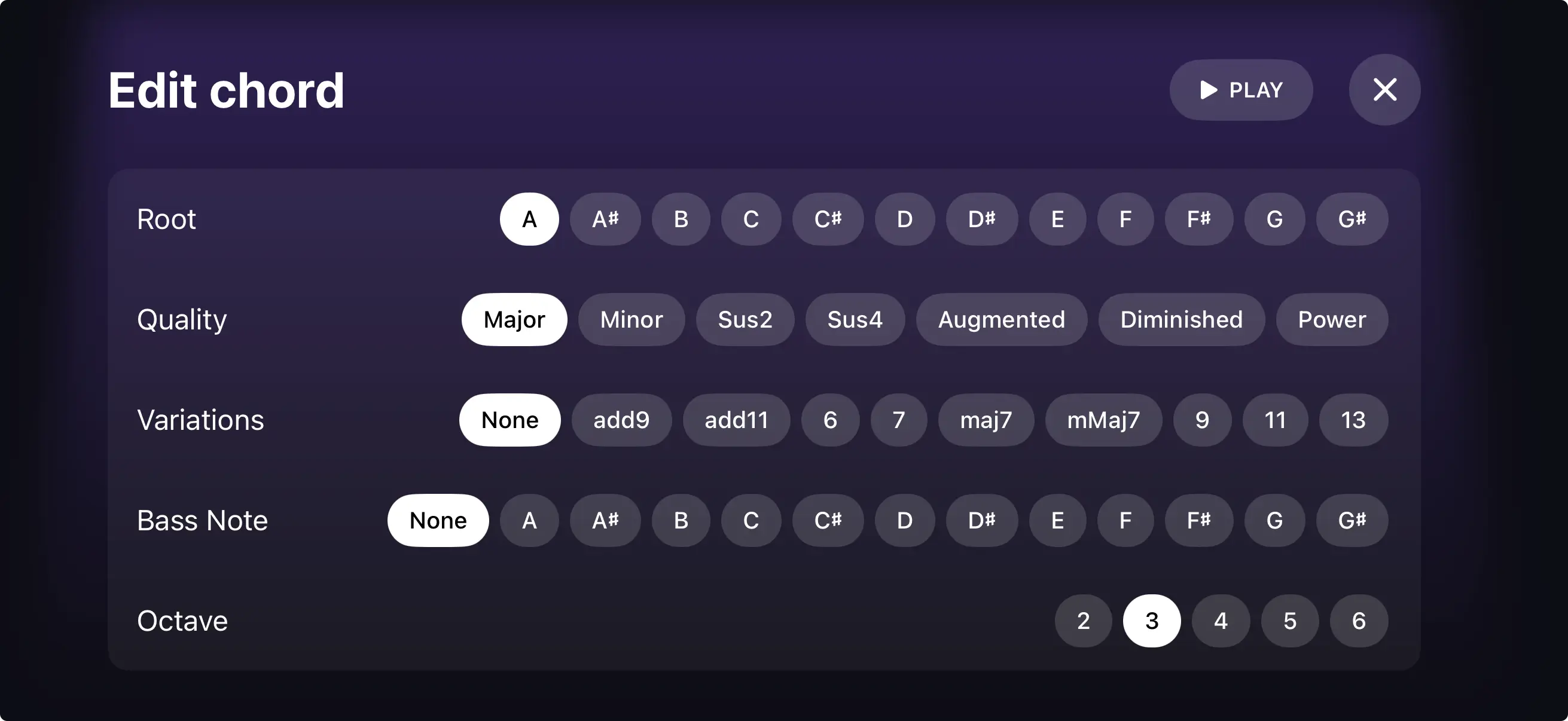
Four chords is plenty. If you don't know which ones belong together, the Chord Builder handles the theory for you: choose a root note and a quality like major or minor, hear it, and keep the ones that sound good side by side. If you're at a computer instead, our free chord player does the same job in the browser. Play your four chords in a loop until moving between them feels natural under your hands.
Put a melody on top
Now hum over your loop. Don't aim for clever, aim for something you could sing back to a friend. Singableness is the real test, and it is the one Arnold Schoenberg uses in Fundamentals of Musical Composition: if you cannot sing it, it is not yet a melody. When you land on a line you like, find those notes on the keyboard. Your chords are already nudging your ear toward notes that fit, so this is far easier than starting from a blank page.
Grow the tune from one small phrase
Here is the technique that separates a tune that goes somewhere from four bars that just stop. You only need one short phrase, two seconds of music, and Schoenberg calls it the basic motive. Everything else grows out of it by what he names developing variation: repeat the phrase, but keep the important part and change the rest.
In practice, keep the rhythm and move the notes. Play your phrase, then play the same rhythm starting a step higher, or over the next chord in your loop. Your ear hears it as the same idea, which is what makes a melody feel coherent, but it isn't a straight repeat, which is what stops it getting dull. Repeating a phrase unchanged is monotonous. Changing everything is incoherent. The middle path is the whole craft.
Give it two parts
A song gets interesting when something changes. Contrast is the engine of the thing, and the simplest working shape is a first section, a contrasting second section, and then the first one back again. Write a second part that genuinely differs from the first: sit it higher, make it louder, hold longer notes, or borrow a chord from outside your loop. Then return to your opening section so the listener feels they have come back somewhere.
Now you have a verse and a chorus, which is most of what a song actually is.
There is one rule about that middle part that is easy to get wrong. It has to contrast without becoming a different piece of music. Keep the time signature and keep the rhythm of your phrase; move the harmony. Schoenberg is unusually blunt about the failure here: contrast with no motivic or metric link back to the opening is, in his words, intolerable in a well organized form. If your second section sounds like it wandered in from another song, that is the reason.
What if the loop sounds finished but goes nowhere?
This is a different problem from the blank page, and it is far more common than anyone admits. You have thirty or sixty seconds that you are genuinely happy with. It repeats. It does not go anywhere. Adding another layer makes it louder, not longer.
The reason is structural, and naming it helps. You are treating the piece as something that grows: start small, add parts, get bigger, end at the peak. That works exactly once, and then you have nowhere left to go, because you spent the whole piece going in one direction. A song is not a loop that grew. It is a statement, a departure, and a changed return.
Arnold Schoenberg calls that shape the small ternary form in Fundamentals of Musical Composition, and writes it A, B, A prime. Your loop is A. You need a B, and then you need A back again, slightly different. Three things make it work, and none of them require more ideas than you already have.
The B section does not need new material. Take the phrase you already have and put it somewhere else harmonically. Same rhythm, different chord underneath. Schoenberg's own smallest recipe for a middle section is two bars plus a varied repetition of those two bars, which is four bars total, so you are not writing a second song. You are writing four bars.
End the B section on the chord that pulls back. In C major that is G. Schoenberg calls this the upbeat chord: it behaves like an upbeat to a downbeat, so the return of your opening lands rather than merely happens. Try it both ways and you will hear the difference immediately. Ending B on C makes the return feel like a restart. Ending it on G makes it feel like an arrival.
Change something when A comes back. Not much. A different last chord, one fewer repeat, the melody an octave up, a bass note held under it. A literal repeat reads as the tape looping again. A changed repeat reads as a return, which is the entire point.
The other half of why a loop cannot end is that nothing in it ever winds down. Schoenberg's term for the wind-down is liquidation, and it is a technique, not an accident: as you head for the last bars, strip the distinctive bits out of your phrase and shorten it. Two-bar phrases become one bar, then half a bar, and the characteristic leap or dotted rhythm gets flattened into plain steps. What is left is neutral enough that it no longer asks for a continuation, which is what lets you stop. A loop keeps its hooks sharp all the way to the edge, so the ear keeps expecting more. That is not a mixing problem. It is the reason it feels unfinishable.
Try this on the loop you already have, tonight: keep it as A, write four bars of B using the same rhythm over different chords ending on G, bring A back with a different final chord, and shorten the last two bars. That is a complete piece, and it is maybe ten minutes of work on material you already own.