If you are choosing between Simply Piano, flowkey, and Yousician, the honest answer is that all three are good, and they are more alike than the marketing suggests. They are all subscription lesson apps that teach piano through a structured path and listen to what you play. The real question is not which is best, it is which one matches how you actually like to learn. Here is how they differ, and when none of them is what you want.
What the three have in common
Before the differences, the shared shape. Each one is free to download, then asks for a subscription once you are past the intro. Each listens through your microphone (or a connected keyboard) and reacts to whether you hit the right notes. Each gives you a graded path from your first note toward real pieces. If you want a course that corrects you as you go, any of the three will do that job well. So the choice comes down to temperament.
Simply Piano: best for a true beginner who wants a course
Simply Piano is the most beginner-forward of the three. It starts from "this is where middle C is" and walks you forward in small, gamified steps, so it is hard to feel lost. If you have never touched a keyboard and you want to be led by the hand, this is the gentlest on-ramp. The trade-off is that once you are past the basics, some people find the lesson-by-lesson structure slow and want to just play.
flowkey: best for learning real songs with video
flowkey leans on a large library of real songs, each with a video of hands playing it, and you can slow a piece down or loop a hard section. It suits people whose motivation is a specific song rather than a curriculum. You still get a beginner course, but the pull is "I want to play that piece," and flowkey is built around that feeling. It works with an acoustic piano through the mic or a MIDI keyboard.
Yousician: best for practice-driven learners across instruments
Yousician is the most game-like, with real-time feedback and streak-style practice goals, and it covers guitar, bass, ukulele, and singing as well as piano. If you like the feeling of a game nudging you to practice daily, or you play more than one instrument, it consolidates that into one app. The flip side is that the gamified pressure is not for everyone.
What if you do not want a lesson course at all?
This is the part the comparison articles skip. A lot of people who search "which piano app" do not actually want a graded course. They want to play songs they like and mess around, and a curriculum would bore them by week two. If that is you, none of the three above is the right fit, and paying for lessons you will not finish is a waste.
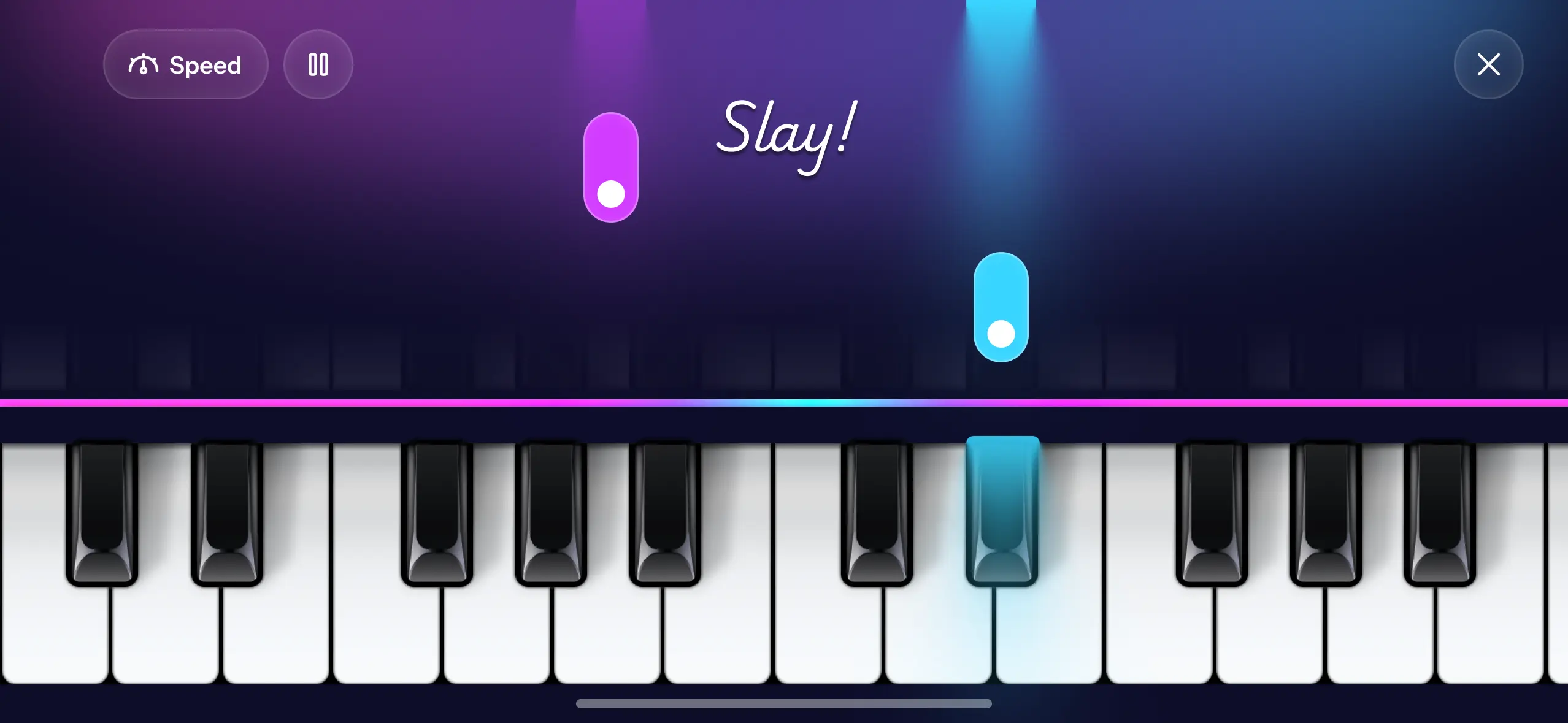
That is a different kind of app. Piano Aura is free to download and sits in this lane: its Piano Game mode drops falling notes down the screen so you press the matching key, no sheet music and no lessons, and you can play recognizable pieces like Clair de Lune, Canon in D, and The Entertainer in your first sitting. You can slow a song to 0.5x while you learn it and speed it back up. Alongside that, the Freestyle keyboard and Create Music let you improvise and record, which the lesson apps mostly do not. Free alternatives to Simply Piano covers this route in more detail.